February 6, 2026 Inside the ski industry’s climate conversations at Prowinter
Does the ski industry have momentum that the outdoor sector currently lacks? Suston’s editor-in-chief, Gabriel Arthur, is positively surprised by Prowinter and the Ski Industry Climate Summit in Bolzano.

A few years ago, ski and snowboard brands began pulling out of the international trade show ISPO Munich. Where did they go instead? The answer: more regional fairs, with a clearer focus on winter sports. In recent years, one of these shows – Prowinter in Bolzano – has become increasingly international. At the same time, more and more outdoor brands are finding their way here.
Bolzano, in Italy’s South Tyrol, has for centuries been a commercial crossroads between the German-speaking regions in the north and the Italian south. Today, this role is embodied by the exhibition halls of Fiera Bolzano, southwest of the city’s picturesque historic center. Among other things, they host the world’s largest trade fair for apple growers.
Fiera Bolzano’s first winter sports fair was launched back in 2001, explains Geraldine Coccagna, Brand Manager for Prowinter.
“At first, it was mainly the large ski rental companies that came here to place their orders for the upcoming season. Later, ski clubs joined and after that, ski retailers.”
“Ahead of 2024, the Italian Outdoor Group asked if we could complement Prowinter with an outdoor trade show.”

More Nordic brands, more outdoor brands at this year’s Prowinter. (Photo: Fiera Messe, Marco Parisi)
Today, a total of 400 brands are exhibiting, says Coccagna. At this year’s January fair, a number of Nordic brands such as Hestra, Icebug, and Norrøna also gathered in a dedicated Scandinavian Village. Anton Magnusson, CEO of Swedish glove maker Hestra, comments:
“I still believe in trade shows – but on a smaller scale, with a clear focus, like this one. A place where brands and buyers can meet, discuss products, and do business. Back to basics, essentially.”
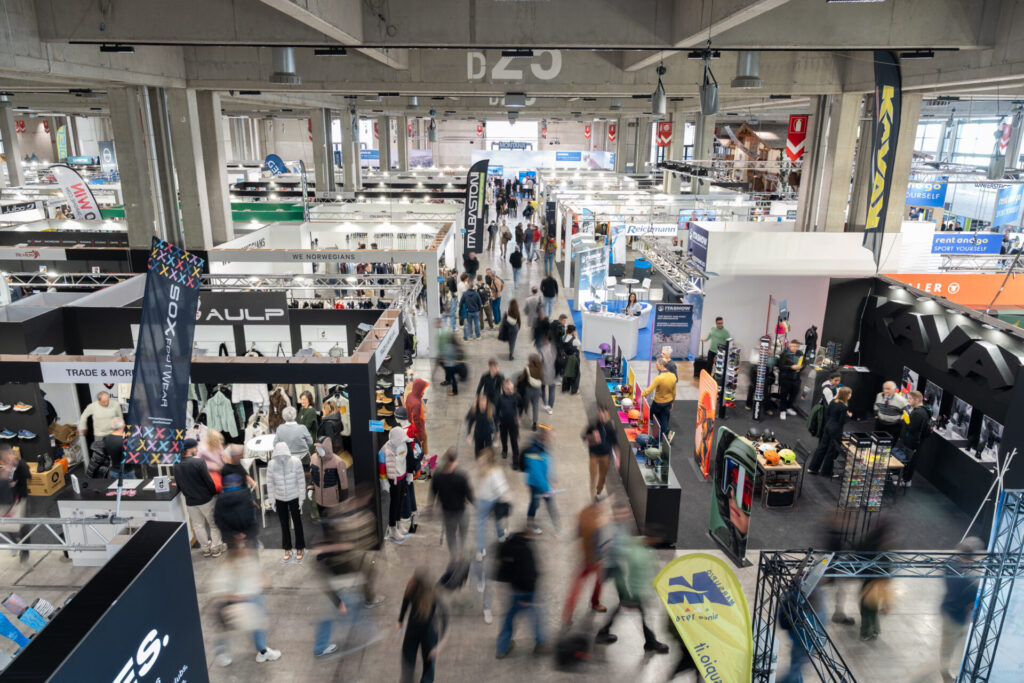
No carpets with PFAS on the hall floors at Prowinter in Bolzano. (Photo: Fiera Messe, Marco Parisi)
Sustainability work behind the scenes
Does this strong product and business focus mean that sustainability has disappeared from the agenda when leading winter sports brands come together? Yes – and no.
For the average visitor, it may appear as if sustainability is a non-issue at Prowinter. Major ski brands are far more eager to talk about new ski models, BOA fastening systems, and lightweight gear for ski touring. When I ask around for sustainability managers who can explain more, I am almost always given an email contact – only a few are actually on site.
Behind the scenes, however, much more is happening. A few examples:
- Fiera Bolzano is aiming to become the most sustainable trade fair organizer in Italy and received its Earth Check Silver Certification in 2025, as the second organizer in Europe.
- Sustainability in design and production is a mandatory criterion in the evaluation of products for the Prowinter Awards. For example, the winner in the Freetouring Skis category, the Dynastar M-Tour 94, features a newly developed core with three layers of wood and reduced use of adhesives and plastics. In some cases, however, it remains difficult to understand exactly which sustainability criteria the winning products fulfill.
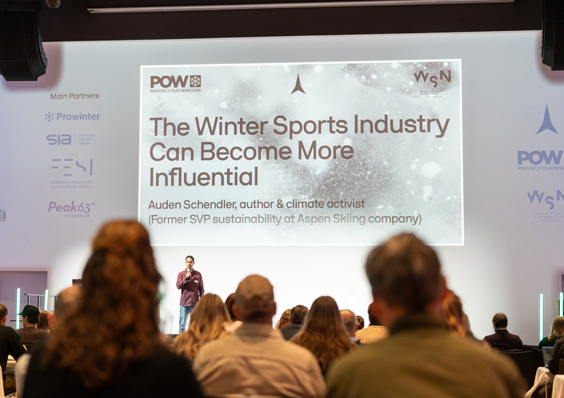
The most important sustainability work, however, takes place outside the exhibition halls, in a conference area connected to Fiera Bolzano. Over three days, key players from the ski and snowboard world gather to exchange ideas and knowledge, network, and build collective momentum.
Winter Sports Sustainability Network – brands working together
Since its launch in 2021, the Winter Sports Sustainability Network has developed into an informal organization where sustainability managers, product developers, and other specialists collaborate – ranging from global giants like Atomic and Rossignol to niche brands such as 1000 Skis. The network is supported by the Federation of the European Sporting Goods Industry and Snowsport Industries America.
Participants are divided into four working groups: Climate; LCA and Footprinting; Ecodesign and Recycling; and Traceability and Compliance. During a full-day session, the groups present their progress and run workshops focused on next steps.
Joel Svedlund, who has many years of experience with similar collaborations in the outdoor industry, believes winter sports currently have a momentum reminiscent of the outdoor sector before the pandemic.
“Every time a World Cup race is broadcast on TV and there’s no snow outside the piste or cross-country track, viewers are reminded that winters are under threat. That makes brands closely associated with snow and winter want to show their customers: ‘We see what’s happening – and we’re acting.’”

Susanna Seif, Sustainability Director at FIS, presenting the federation’s strategy. (Photo: Atomic, Marco Parisi)
Ski industry climate summit – focus on action
The invitation to the two-day Ski Industry Climate Summit reads: “Together, we can lead a mass movement to build a sustainable future for winter sports.”
This annual event is organized by Atomic and Protect Our Winters Europe. The audience is broad, with representatives from alpine resorts, international ski federations, researchers, and legal experts also taking part.
The presentations come thick and fast. I’m personally surprised to hear that the ski and snowboard industry is, for now, still performing well financially. At the same time, everyone agrees that the long-term outlook is bleak. In practice, only high-altitude resorts will be able to rely on downhill skiing as their main revenue stream going forward. The rest will need to adapt by diversifying their offerings.
There is an energy and sense of forward momentum at this summit that I’ve missed at similar outdoor conferences in recent years. It is also striking how activist organizations like Protect Our Winters are not seen as a threat by the industry – as environmental NGOs often are – but rather as collaborative partners.
Can the industry become a new pioneer?
In many industries, sustainability strategies have rapidly gone from being a must-have to merely nice-to-have. At the moment, such strategies are not widely perceived as business-critical.
Is the ski and snowboard industry on track to become a pioneer – one that recognizes that deep, systemic change is necessary for long-term economic survival?
Participants at the Ski Industry Climate Summit certainly believe so.
But the road ahead will be long. For now, it is still very much business as usual in the exhibition halls a few hundred meters away.
Also read Gillian Rosh and Ashley Perl’s report from the Ski Industry Climate Summit.
Lead photo: Atomic, Marco Parisi