


In under five kilometers, the same river can look different depending on where you stand. Around thirty outdoor industry professionals walked the length of Italy’s Sarca River during European Outdoor Week to see how dams, weirs, and renaturalization have reshaped one Alpine waterway.
On Saturday, May 16, 2026, around thirty outdoor industry professionals gathered on the banks of the Sarca River in the Italian Alps for a citizen science walk organized by European Outdoor Conservation Association (EOCA) and River Collective, with support from MagNet, as part of European Outdoor Week. Italian actress Anna Favella joined as ambassador for the event. Over less than five kilometers, the group traced how human intervention has altered the waterway, from its course through the mountains to where it meets Lago di Garda at Torbole.
Scoring the Sarca River’s health
The walk moved through four sections: a renaturalized stretch, a fish farm, a hydroelectric power plant built in 1961, and a canalized section near the river’s mouth. At each stop, participants scored the river’s condition using a protocol that assessed bank condition and how much room the river had to shift its course.
The renaturalized section scored highest. The hydroelectric plant, with concrete banks and an impassable weir, scored lowest. According to the organizers, weirs of this kind disrupt fish passage, block sediment flow, and fragment river ecosystems.
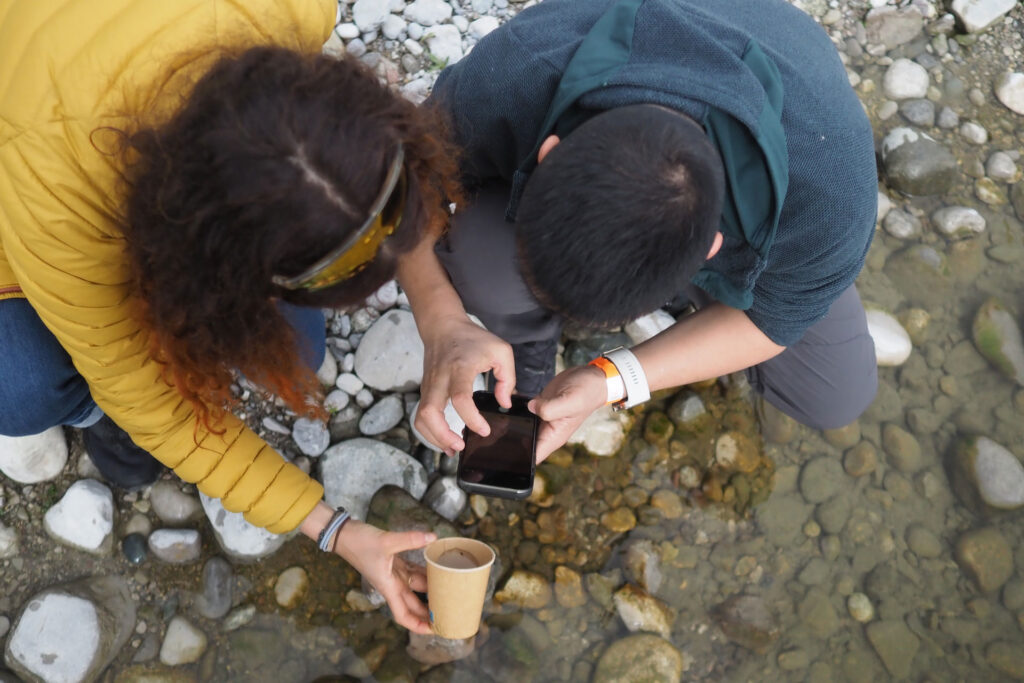
(Photo: EOCA)
Counting biodiversity along the route
The group carried out two ten-minute biodiversity counts using the iNaturalist app, one at the renaturalized site and one at the canalized section near the lake. At the renaturalized site, participants logged 49 observations across 20 species. At the canalized site, that fell to 16 observations across 11 species, including flatheaded mayfly larvae, free-living caddisflies, great crested grebes, and field horsetail.
The organizers noted this was not a formal study, but the pattern held across both sites: the more natural the stretch, the more species it supported.

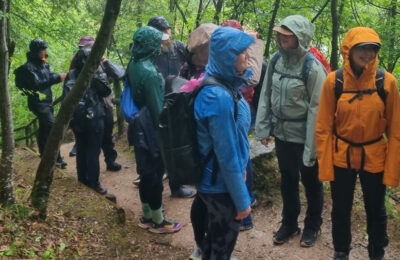
Participants who felt “Connected” are to the right, “Not connected” to the left. (Photo: EOCA)
A measurable sense of river connection
Participants were also asked to position themselves along a line representing a range from “disconnected” to “deeply connected” at each stop. At the renaturalized section, the group clustered toward the connected end. At the hydroelectric plant, they spread out toward the other.
One participant said:
“The difference in how I felt between the locations was striking. Our human infrastructure disconnects us from the natural world, not just physically but emotionally.”
The exercise led to a discussion of the outdoor industry’s role in restoring the conditions for that connection and keeping such spaces accessible.
Shifting baselines for river health
A recurring theme of the day was the concept of shifting baselines: as canalized and dammed rivers become the norm, each generation grows up with a narrower reference point for what a healthy river looks like, with consequences for how conservation goals get set. The walk’s findings and route have since been compiled into an interactive ArcGIS StoryMap combining maps, photography, and geographic data for those who were not on-site.
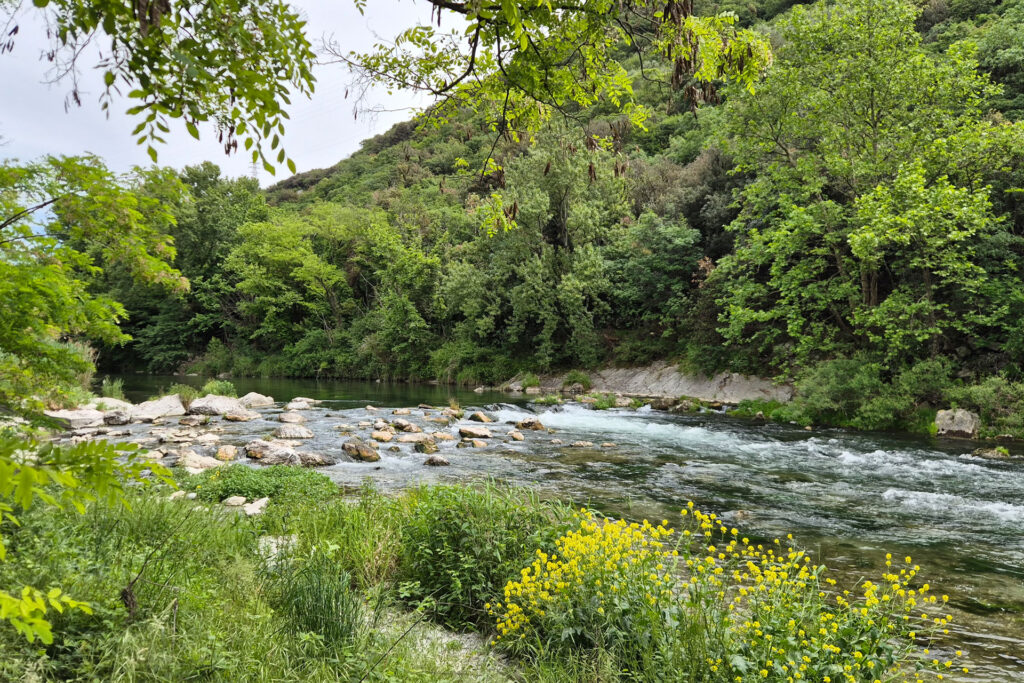
(Photo: EOCA)
About EOCA
EOCA enables its membership from the outdoor sector to create a positive impact on nature, biodiversity and wild places. It provides a mechanism for companies to invest in conservation and restoration projects globally, and advocates for progressive nature supporting legislation at an EU and UK level.
About River Collective
River Collective is a network of students, academics, researchers and conservationists focused on healthy, free flowing rivers. They combine resources and expertise to provide place-based outdoor education, citizen science, and recreational events.
Lead Photo: Giacomo Tonoli


Sorry, the comment form is closed at this time.