July 10, 2026 Vaude and UPM win Ernst Pelz Award for wood-based fleece
Vaude and UPM developed the world’s first fleece jacket made from wood-based polyester, earning this year’s Ernst Pelz Award.
The Ernst Pelz Award recognizes innovative solutions that successfully bring renewable raw materials into industrial applications. For UPM and Vaude, the award also acknowledges their long-standing collaboration in advancing a more climate-friendly and circular textile industry.
The textile industry faces the challenge of reducing its dependence on fossil-based raw materials while meeting the growing global demand for high-performance textiles. Recycling remains a key pillar of this transition but, on its own, will not be sufficient to meet future raw material demand. Renewable feedstocks are therefore needed to complement recycling and replace fossil carbon sources in materials such as polyester.
The jointly developed fleece jacket combines both approaches. Made from wood-based polyester, it demonstrates that high-performance outdoor apparel can already be produced using renewable raw materials today. At the same time, the material is compatible with existing manufacturing processes, providing a realistic pathway toward industrial-scale production.
“Recycling will remain indispensable, but it alone will not be enough to eliminate fossil raw materials from the textile system. The world’s first fleece jacket made from wood-based polyester demonstrates that renewable carbon can create the link between climate protection, circularity, and industrial scalability,” says Dominik Müller, Senior Manager Sustainability & Market Development, UPM Next Generation Renewables.
René Bethmann, Innovation Manager at Vaude, shares that view.
“With our fleece jacket made from wood-based polyester, we are demonstrating that renewable raw materials can be a genuine alternative to fossil-based materials. Innovations like this are only possible through strong partnerships across the value chain. Receiving the Ernst Pelz Award encourages us to continue on this path together and actively help shape the transformation of the textile industry,” says Bethmann.
Partnerships as the key to transformation
The Ernst Pelz Award recognizes not only a pioneering material innovation but also the close collaboration across the value chain. UPM and Vaude demonstrate how renewable raw materials and circular economy approaches can complement one another to gradually replace fossil resources and bring tangible climate and resource protection solutions into practice.
The Ernst Pelz Award includes prize funding of €10,000. UPM and Vaude will use the funds to further develop and commercialize their joint material innovation. This will support the transfer of wood-based polyester from development into industrial application and demonstrate how renewable carbon can gradually replace fossil raw materials in textile production.
About Vaude
Vaude is a family-owned outdoor brand based in Tettnang, Germany, offering products for mountain sports and cycling. Founded in 1974, the company operates an EMAS-certified environmental management system and a science-based Net Zero climate strategy validated by the Science Based Targets initiative (SBTi). Vaude is a member of Fair Wear and manufactures a selection of products at its own production facility in Tettnang.
About UPM
UPM Next Generation Renewables is a strategic growth business of UPM that produces wood-based alternatives to fossil raw materials, including renewable fuels, chemicals and functional fillers, from biorefineries in Lappeenranta, Finland, and Leuna, Germany. UPM is a material solutions company employing approximately 15,100 people worldwide, with annual sales of approximately €9.7 billion. Its shares are listed on Nasdaq Helsinki Ltd.
About the Ernst Pelz Award
The Ernst Pelz Award has been presented by the Ernst Pelz Foundation since 1992 and recognizes innovations that bring renewable raw materials into industrial use. It is presented jointly by two Bavarian state ministries in cooperation with C.A.R.M.E.N. e.V. as part of the annual C.A.R.M.E.N. Symposium in Straubing.
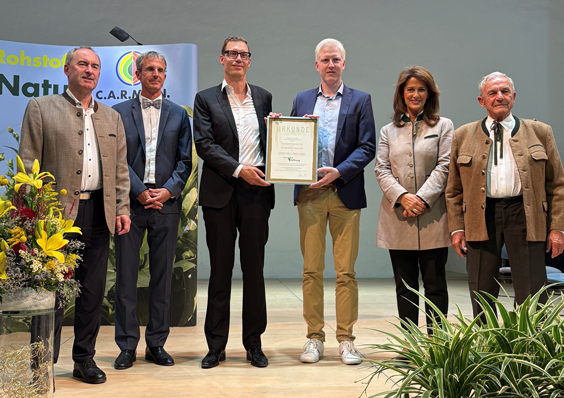
Lead image:
From left to right: Hubert Aiwanger, Bavarian Minister of Economic Affairs, Regional Development and Energy; Jochen Pelz, Member of the Board of the Ernst Pelz Foundation; René Bethmann, Innovation Manager at VAUDE; Holger John, Sales Manager at UPM Next Generation Renewables; Michaela Kaniber, Bavarian Minister of Food, Agriculture, Forestry and Tourism; Peter Pelz, Founder and Chair of the Ernst Pelz Foundation Board of Trustees. (Credit: Vaude)