May 14, 2025 New Patagonia book digs into regenerative agriculture and the farmers trying to save the earth
“Regenerating Earth” highlights farmers on the leading edge of fighting climate change, regenerating our home planet, and rebuilding our communities.
Kelsey Timmerman, the New York Times bestselling author of Where Am I Wearing, Where Am I Eating? and Where Am I Giving?, has spent a lifetime asking big questions and traveling the world in search of answers. In his latest book, Regenerating Earth: Farmers Working with Nature to Feed Our Future, he embarks on his most personal and transformative journey yet – one that doesn’t just change how he sees the world, but how he lives in it.
From Indiana’s cornfields to global regenerative communities
Timmerman comes from a long lineage of farmers and lives in rural Indiana where his neighbors are fields of monoculture corn and the farmers who tend them. He sees firsthand the damage that modern industrial agriculture inflicts on the health of our land,
ourselves, and our communities—farm runoff pollutes ponds, manure from factory farms impacts air quality, and connections between farmers, neighbors and consumers are fractured.
Determined to find a better way forward through an understanding of the regenerative agriculture movement, Timmerman embarked on the journey that became Regenerating Earth. Over five years he traveled across the U.S. and beyond, meeting farmers and activists embracing regenerative practices. His global adventure takes readers to melting glaciers in Patagonia, into the Amazon, and down forgotten rivers. He protected a herd of cattle from lions alongside the Maasai warriors of Kenya, saw firsthand how chocolate could save the rainforest in Brazil, and met American farmers rejecting the agrochemical industry in favor of a land stewardship approach rooted in Indigenous wisdom.
Indigenous wisdom and the roots of regenerative agriculture
On different continents and across different cultures, he discovered a way of life and work that respects nature, fosters resilience, and restores balance. The outcomes of regenerative agriculture may look different, he says, but regenerative farmers understand that agriculture is not the problem in today’s environmental crisis; it is the cure.
“Regenerative agriculture isn’t an exciting new thing. Regenerative agriculture is an exciting old thing. As it’s been practiced by Indigenous people for thousands of years,” writes Timmerman.
“It is not centered on extraction but on living in balance with the natural world. It is not just about farming, but about our relationships with science and technology, each other, and ourselves. While it’s grounded in the soil, it’s about human rights and environmental justice, about diversity versus monoculture, the pursuit of profit versus life.”

Volunteers roll a giant dibber wheel through the rich, soft soil at Huerto Cuatro Estaciones in preparation for planting. Regenerating Earth and ourselves requires feet in the soil and our hearts and hands at work. (Credit: © Cliff Ritchey)
Restoring soil, biodiversity and human connection
With a thoughtful blend of investigative journalism and vivid storytelling, Timmerman highlights innovative growers who are restoring soil health, promoting biodiversity and sequestering carbon to help mitigate climate change. From traditional Hawaiian kalo patches to the Amazon rainforest and the Kenyan savanna, he learns from Indigenous communities and regenerative pioneers who have long practiced sustainable land stewardship.
“I hold onto hope that we can change,” he says.
“That hope is buoyed by those I’ve met on this journey, people who are taking on the powerful forces of commodification, consolidation, industrialization, greed, and are rebuilding lost connections. This is global work that requires us each to be regenerative champions in our local communities.”
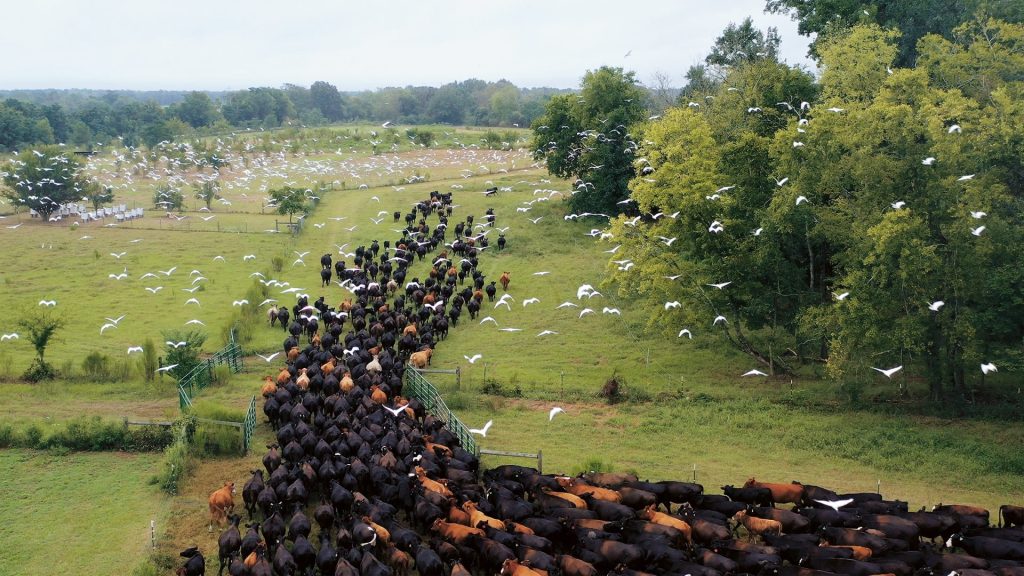
Learning from his own observations and Allan Savory’s teaching on holistic management, Will mimics nature by bunching and herding his cattle. (Credit: © White Oak Pastures)
Daily choices and local action for global change
Regenerating Earth shows readers how their daily lives, eating habits, and relationship with nature connect to issues of environmental and social justice. Humans don’t have to be the destroyers of Earth, Timmerman says – in fact, our connection with nature is critical to Earth’s renewal.
About Kelsey Timmerman
Kelsey Timmerman is a journalist and public speaker whose books explore the human stories behind global economic systems. His work connects readers with the people and places impacted by the products they consume, revealing the deeper relationships between consumption, labor, and sustainability.
Lead Photo: Welcome to an organic farm on the island of Kaua’i, founded after residents stood up against some of the largest agrochemical companies on Earth. (Credit: © Kelsey Timmerman)